
In the early 1800s, the novels of Edinburgh-born Susan Edmonstone Ferrier were so successful they commanded higher advances than even those paid to her most illustrious contemporary, Jane Austen. As was customary for novelists in the early nineteenth century, the texts were published anonymously, and their wild early popularity partly stemmed from sharply satirical depictions of characters based upon real people. As with the works of Austen, Ferrier’s books avoided melodramatic or convoluted plots, concentrating instead on sophisticated and witty observations of contemporary society. Her readers gossiped relentlessly on who could possibly be the real-life inspirations for figures like Lady Maclaughlan or Lord Rossville. Ferrier herself knew this all too well, observing: “Everybody knows who the characters are, but no two people can agree about them. I have heard of five or six Lord Rossvilles”. The critical and commercial success of her first novel, Marriage, whose first edition in 1818 sold out within six months, was so comprehensive many readers thought it was the work of the most successful author of the time, Sir Walter Scott.
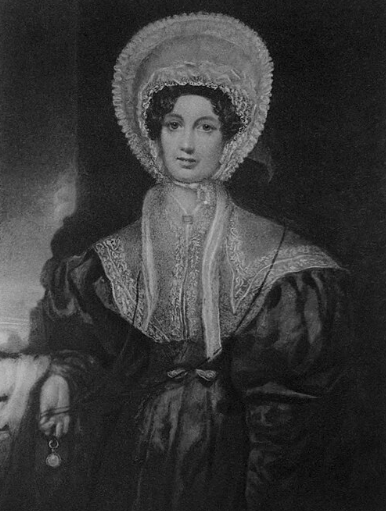
Susan Ferrier from an engraving after the 1836 portrait by R. Thorburn.
Written in a realist style laced with biting humour, Ferrier’s plots had a particular focus on the dilemmas faced by women. With the elegant single-noun titles of Marriage, The Inheritance and Destiny, readers in the early 1800s recognised in Ferrier’s narratives situations they themselves were confronted with in daily life. Her observations were conveyed in a shrewdly observant tone frequently satirising contemporary Romanticism, social pretension and sentimentality. In particular, the limited ways in which women could exercise any autonomy over their own lives through marriage, inheritance, or a skilful negotiation of the rigid social hierarchy of the time were central to Ferrier’s plots. More widely travelled than Austen, she was able to accurately convey life across the breadth of Great Britain, from the bleak, wild remoteness of the Western Highlands to the conspicuous consumption of bustling central London. Again, in contrast to Austen, as Val McDermid noted in her introduction to the Virago edition of Marriage, “[Ferrier’s] canvas is broader: her world includes the servants and much more domestic detail than Austen, and this makes for a richer portrayal of the period”. Sir Walter Scott felt that of all his competitors, male or female, she was the most likely successor, declaring her his “sister shadow” and “the most worthy to gather in the large harvest of Scottish fiction”.
Susan Edmonstone Ferrier was born on 7 September 1782 in Lady Stair’s Close in Edinburgh’s Old Town to James Ferrier WS and Helen Coutts. By the 1790s the Ferrier family was a large one, comprising nine children, and the WS Society was to play a large part in the family history for several generations. Three of Susan’s brothers, Archibald, James and Walter, followed their father and became Writers to the Signet. The elder James Ferrier WS was instrumental in ensuring his daughters received a private schooling, since, unlike many men of his time, he believed in the proper education of women. Although Susan’s tuition took place at their New Town house on 11 George Street, where the family had moved when she was two years old, her father’s place in the Edinburgh legal establishment ensured she and her siblings came to know all the notable figures of Enlightenment Scotland. It was not at all unusual for a legal background to be the precursor to a successful literary career, as the examples of two of James Ferrier’s colleagues and friends, Sir Walter Scott and Henry Mackenzie, amply demonstrated.
Of all his children, James Ferrier would perhaps become closest to Susan. Unlike her three sisters, she did not marry, and following the death of her mother in 1797, as was common for unmarried women at the time, she kept house for her father and conscientiously concerned herself with the family lives of her married siblings. In 1804 she described her daily life in Edinburgh as “writing to my sisters three, sewing my seam, improving my mind, making tea, playing whist and numberless other duties”. James Ferrier had risen from very modest beginnings to reach the top of the legal profession as lawyer to the greatest and most powerful aristocrat in Scotland, John, 5th Duke of Argyll. Ferrier’s social circle included such legendary names as Robert Burns, James Hogg and Dr Johnson. James was born in 1744, the son of a gentleman, John Ferrier of Westport Linlithgow, and his wife Grizel, described in the History of the Society of His Majesty’s Signet as “daughter and heiress of Sir William Sandilands Hamilton, Bart., of Westport and Belsyde”. For some mysterious reason, when still an infant James was handed over to the care of an impoverished nurse in her humble home. As he grew older his parents seem to have made an attempt to reclaim him, upon which the boy very firmly refused to leave Nurse Barr, to whom he was now fondly attached. As Susan later noted in her Memoir and Correspondence, any mention of a separation resulted in his behaviour becoming “so stubborn and woeful” that young James’ parents relented. They allowed him to remain in his adopted home and paid for his clothing and education.
“In private the two young women would giggle together over the airs and pretensions of many of the guests at Inveraray.”
After attending the grammar school of Linlithgow, at the age of 14 James became a clerk in the office of his father’s law agent, Mr Archibald Campbell WS of Succouth. This was a prestigious placement since Campbell’s elder son, Ilay, would become Lord President of the Court of Session, and his clients included the Dukes of Argyll. It was Archibald Campbell’s intention to name his younger son as heir to his business but, when the young man died unexpectedly, he turned instead to his protégé James Ferrier to succeed him. In 1767, James married Helen Coutts, and on 3 July 1770 he became a Writer to the Signet. As Commissioner for the Duke of Argyll, James could not have had a more valuable and influential client and, in his legal role, he made frequent trips to the magnificent ducal seat of Inveraray Castle in Argyllshire. To visit the incredible papers of the Argyll Archives at Inveraray Estate is to see a testament to all his work for the Campbell dynasty. Over and over again the signature “Ferrier” appears in his distinctive, looping script in correspondence about leases, feus, contracts of works and other estate affairs.
As Susan grew older, she began to accompany her father on these trips into the Highlands. Inveraray Castle was hardly a typical Highland residence. Conceived over decades by the Adam family of architects, its development had included the removal of the entire old village of Inveraray and the construction of a new model town outside the castle boundaries. The Duke and his Duchess, Elizabeth, were at the top of Georgian society, not just in Scotland but across Europe. A famous beauty, the Duchess of Argyll was a favourite of both King George III and Queen Charlotte, who gifted her magnificent portraits of the royal couple which hung in pride of place on the castle’s grand staircase. Befitting this ducal status, Inveraray Castle was decorated and furnished with all the sophistication and taste of aristocrats who travelled widely on the continent. At Inveraray, Susan was in the presence of some of the most celebrated people in society. She became great friends with a niece of the Duke’s, Charlotte Clavering, who was twelve years her senior and a passionate fan of the Gothic novels enjoying such a fashion at the beginning of the nineteenth century. In private the two young women would giggle together over the airs and pretensions of many of the Guests at Inveraray. Discovering a shared passion for modern novels, they became absorbed in the idea of writing a book based on observations of some of these characters who, they confessed to each other, they found so awful. This was the genesis for what would become Marriage. As Susan began writing, she found herself growing more enthusiastic for the style of social realism just beginning to develop in new fiction. Ultimately, this meant Charlotte’s contribution would eventually diminish to just one chapter, describing the history of the heroine’s mother.
It is clear Susan had ambivalent feelings about these literary endeavours, demonstrated by her extreme circumspection around sharing any of her work with her father. Indeed, when she began to read to him from the manuscript of Marriage, she would only do so from behind a screen so that he was unable to see that she was not reading from a published work. When she had finished, her father pronounced what she had just read him “the best book you’ve ever brought me”. Undoubtedly much of her wariness centred on the fear of the inevitable gossip and speculation that always surrounded a successful novelist, most especially a female one. The novel itself satirises the disapproval many older people felt towards the younger generation, particularly the younger female generation, in respect of their notable enthusiasm for novels. Mary, the heroine of the story, is criticised for it: “I’m certain indeed [...] that reading does young people much harm. It puts things into their heads that never would have been there but for books. I declare, I think reading’s a very dangerous thing; I’m certain all Mary’s bad health is entirely owing to reading”.
When Marriage was published to such enormous success, neither Susan nor the Ferrier family enjoyed the attention its acclaim brought, nor the guessing games around dinner tables as to who could be the inspiration for the imperiously stupid society matron or pontificating military bore. Writing to her sister she exclaimed, “I could not bear the fuss of authorism!” Of course, beneath the wit, Marriage was also addressing serious issues concerning the peril women faced in choosing the wrong husband, on marrying for love rather than security and ending up penniless, or on accepting a dull but reliable suitor and resigning to a loveless union. Although Susan’s desire to remain anonymous was sincere, she still felt a strong motivation to write more, and so whilst living with her father at a summer house in Morningside, then on the outskirts of the city, she completed her second novel, The Inheritance. Published by Blackwood in 1824, it was another immediate success and friends, including Scott and the Argylls, recognised in the character of Uncle Adam Ramsay an affectionate portrait of her father James.
From 1802 until he retired, James Ferrier was a colleague of Sir Walter Scott when both were Principal Clerks of Session in Edinburgh. Susan and her father visited him at Abbotsford on several occasions and she and Scott found each other delightful company. Scott observed in his Journal that Susan was “exceedingly ready at repartee” and he helped her negotiate an improved fee with a new publisher, Robert Cadell, for her final novel, Destiny. Dedicated to Walter Scott, Destiny was also enthusiastically received although it was more moralising in tone, with most of the humour confined to the figure of the minister Mr McDow: “Mr McDow’s principal object in the world was self, and his constant and habitual thoughts had naturally operated on his outward manners to such a degree as to blunt all the nicer perceptions of human nature, and render him in very truth his own microcosm”.
James Ferrier died in 1829 aged 85 and his old friend Walter Scott recorded in his diary, “Honest old Mr Ferrier is dead at extreme old age”. Susan’s health was also deteriorating. For many years her eyesight bothered her and headaches meant she had to spend more time in a darkened room, often cared for in London by her sister. Still, she maintained a cheerful correspondence with family and friends. Her novels remained popular throughout the nineteenth century, and the sale of her copyright to Richard Bentley in 1841 resulted in new illustrated versions of her works. Finally, in 1851, just three years before her death, Bentley reprinted this edition with her name appearing as the author for the first time.
“She is as worthy as Scott, Conan Doyle and Stevenson of a place in the pantheon of Scottish letters.”
Susan Ferrier died in her brother’s house at 38 Albany Street in Edinburgh on 5 November 1854 and was buried in the famous old Edinburgh churchyard of St Cuthbert’s. Editions of her works, now including Memoir and Correspondence, continued to appear throughout the nineteenth century, but for some reason, whilst Jane Austen continued to be published throughout the twentieth century, her Scottish contemporary fell into obscurity. Although the History of the Society of Writers to His Majesty’s Signet proudly notes James Ferrier WS as “Father of Susan Edmonstone Ferrier, Novelist”, she was all but forgotten by literary Scotland for many decades. Now she is being championed again by Scottish writers like Val McDermid, who argues: “She is as worthy as Scott, Conan Doyle and Stevenson of a place in the pantheon of Scottish letters that led to Edinburgh being recognised as the first UNESCO City of Literature. Read her and find out for yourself”.
This article was originally published in The Signet magazine (Issue 17, January 2025).