
Lucy, Peter and William participated in the WS Society Summer Scholars programme during July 2026. This article summarises their research and presentation.
PART 1: THE NEW POLICE
Fourteen years after the creation of a new Scottish police force, and public trust in constables is crumbling. An ex-police sergeant, discharged for gross misconduct, has colluded with a senior officer to embezzle public funds. An internal investigation finds no fault. The officers responsible evade accountability.
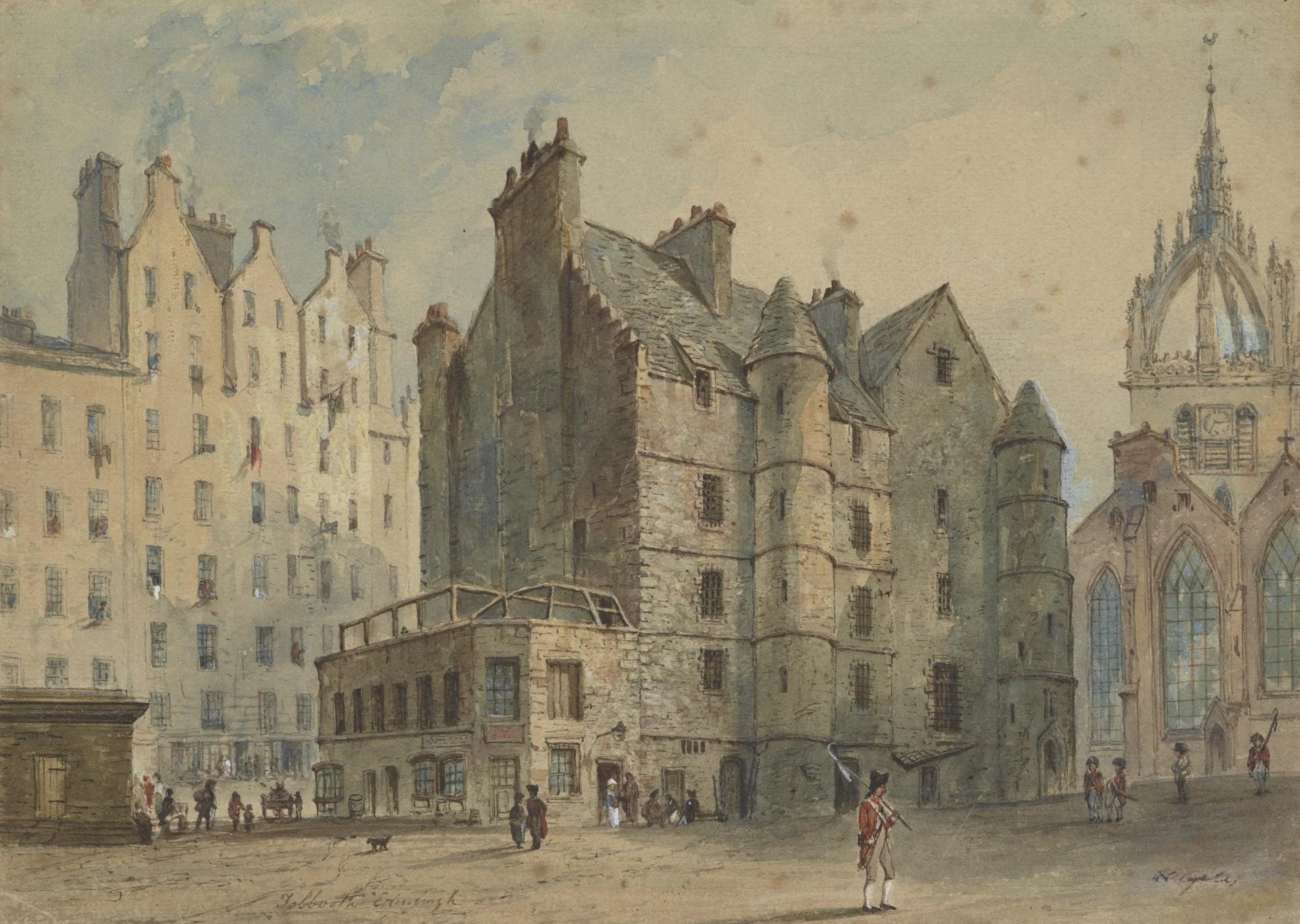
Figure 1 - The Old City Tolbooth and St Giles’ Cathedral, by Henry Gibson Duguid (1805–1860). A municipal building until demolition in 1817.
The year is 1819, and The Broom Scandal has no sooner swept through the City of Edinburgh then it is swept under the rug. Established under the Edinburgh Police Act of 1805, city constables were respected members of the mercantile class, selected for integrity, and fairness.
Until an independent annual audit by the Cleansing Committee stumbled upon a fraudulent scheme. A barred police sergeant, Forsyth, had conspired with the Principal Police Clerk to create phantom bills for brooms. Over a six-year period, the force allegedly purchased 169,572 brooms, the equivalent of £100,640.08 of today’s money, at the public’s expense.
The 1819 Broom Scandal is the first example of institutional misconduct in new Scottish policing. Two centuries later, as we approach the fourteenth anniversary of Police Scotland, the Police (Ethics, Conduct and Scrutiny) (Scotland) Act 2025 (“PECS”), addresses the same institutional weaknesses by embedding ethical policing standards in law and strengthening independent scrutiny.
The Culture of Police Scotland.
The police do a difficult job that is often misrepresented in the media and misunderstood by the public. A shared experience fosters solidarity within Police Scotland, but these same bonds can also become barriers to challenging misconduct.
In May 2023, the Chief Constable Sir Ian Livingstone acknowledged that a lack of policy, processes and practice meant the service was institutionally discriminatory. Recognising the existence of racism, sexism and misogyny, Police Scotland has since committed, through its Policing Together Strategy and Vision 2030, to do what Assistant Chief Constable Catriona Paton has described as a ‘duty to deliver meaningful cultural change’.
However, internal audits by HMICS have found that misconduct and grievance processes are widely mistrusted, leading to severe under-reporting of inappropriate behaviour out of fear of professional retaliation. Against this backdrop, this article seeks to answer to what extent a duty of candour and a code of ethics changes the culture of Police Scotland.
PART 2: A CANDOUR ATTITUDE
PECS aims to increase police accountability, integrity, and public trust in Scotland by amending the Police, Public Order and Criminal Justice (Scotland) Act 2006 and the Police and Fire Reform (Scotland) Act 2012, and introducing:
A statutory duty of candour: requiring officers to be open, truthful and cooperative during inquiries and investigations.
A code of ethics: establishing a formal code for all Police Scotland officers and staff.
A barred and advisory list: creating an advisory list for officers under investigation for gross misconduct and a barred list for those dismissed.
Enhanced vetting: introducing continuous vetting throughout an officer's career and broadening the oversight powers of the Police Investigations and Review Commissioner (PIRC).
“It is the function of the public authority itself to draw the Court’s attention to relevant matters… to identify ‘the good, the bad and the ugly’”
Does a duty of candour change police culture?
From R v Bembridge (1783) to R (Citizens UK) v Secretary of State for the Home Department (2018), we expect public servants to act honestly because they exercise powers entrusted to them by the public. Police Scotland now joins a trend established by Scottish health and social care services in elevating a duty of candour from a professional standard to a statutory obligation.
Under Section 3 of PECS, officers must proactively disclose relevant information, even when it has not been requested. Crucially, the obligation extends beyond individual constables to Police Scotland as an institution, shifting accountability from individual "bad apples" to organisational responsibility.
However, the individual duty of candour applies to ‘office holders’ (like constables) not ‘employees’ (like police staff). This creates a gap in the law. For example, police staff who have operational roles such as Police Custody and Security Officers may be witness to a constable using unreasonable force but would be under no obligation to proactively give this information — a hurdle to creating a culture of openness.
Importantly, the duty closes the long-criticised ‘resignation loophole’ by allowing misconduct investigations to continue after a constable has left office. Accountability cannot be avoided through resignation. However, this reform raises fresh concerns regarding proportionality and Article 8 ECHR. If professional integrity has a longevity that outlives an officer’s post, PECS should define the boundaries between professional accountability and personal privacy. Otherwise, this increased scrutiny could discourage prospective recruits from a career in policing.
“Sunlight is the best disinfectant”
Does a code of ethics change police culture?
The Code of Ethics influences police culture, but with unintended consequences. Following the 1990s cash-for-questions scandal, Lord Nolan famously created Seven Principles of Public Life that continue to guide ethical standards in the UK public sector today. However, Lord Nolan knew that ethical conduct cannot be achieved through rules alone. He therefore interwove these principles with three ‘golden threads’:
1. Codes of Ethics
PECS establishes a statutory Code of Ethics reflecting four core values — integrity, fairness, respect, and human rights — and to be reviewed by the Chief Constable every five years. This allows the Code to evolve alongside operational changes, public expectations and lessons learned from major incidents. However, its current emphasis on individual accountability obscures wider organisational failings, such as inadequate training, supervision or institutional culture.
2. Independent scrutiny

Figure 2 - Code of Ethics for Policing in Scotland. There is a statutory duty to make the code publicly available on the Police Scotland website.
Consultation with officers with protected characteristics, and oversight bodies like PIRC, COPFS, and HMICS, helps ensure transparency. However, as a statutory instrument the Code risks being diluted by judicial review as the Court of Session applies legal standards to professional independent policing decisions.
3. Education
By requiring that all constables and police staff understand the Code affirm it through the amended oath of office, PECS promotes ethical decision-making and fosters a shared professional identity. As a mission statement, it is deliberately aspirational, creating a reflective ‘no blame’ culture. However, once incorporated into statutory frameworks, these broad, undefined principles become regulatory rather than aspirational. Without clearer definitions of the standards they impose, there is a risk that general statements of professional conduct will be used as disciplinary benchmarks.
“The patronising disposition of unaccountable power”
PART 3: LESSONS AND LEGISLATION
Although PECS is not retrospective, past and present public inquiries provide a useful basis for assessing whether duties of candour and ethical codes could have influenced police culture to prevent miscarriages of justice. We will examine three:
1. The Hillsborough Inquiry.
Tragedy has often produced legislation, but legislation alone has not always produced cultural change. The stadium disasters of the 20th century are evidence of an inability to break the cycle. After the 1946 Burnden Stadium Disaster, the Moelwyn Hughes report followed, introducing advice on crowd control. Yet the remainder of the century saw the Ibrox stadium crush of 1971 and the Hillsborough disaster of 1989. Inquiries and recommendations alone do not produce lasting cultural change.
The Public Office (Accountability) Bill, originally introduced as Andy Burnham MP’s Private Members’ Bill in 2017 before falling at the end of the parliamentary session, was revived as a commitment in the Labour Party’s 2024 Manifesto under Keir Starmer’s leadership. Dubbed the ‘Hillsborough Bill’, it proposes a statutory duty of candour and a criminal offence of ‘misleading the public’ during investigations into public-sector misconduct. Whilst the Hillsborough Bill seeks to challenge institutional defensiveness, PECS aims to influence ‘cultural and behaviour changes at all levels of policing’. The Scottish approach is more restorative than punitive; that is its strength. Legislators should not downplay the effect on the public of seeing a constable on trial. Instead of ‘rooting out bad apples’, seeing a constable on trial typically produces an exaggerated picture of misconduct. Breaches of the duty of candour are serious but should support a culture where officers feel able to disclose mistakes, challenge poor practice and contribute to organisational learning.
2. The Sheku Bayoh Inquiry.
In 2015, Sheku Bayoh died after being restrained by police in Kirkcaldy. Rather than a Fatal Accident Inquiry, the Scottish Government established a statutory inquiry under the Inquiries Act 2005 to examine the police response after his death.
Had the Hillsborough Bill been in force, Lord Bracadale would have issued immediate compliance directions. Instead of asking Police Scotland to "produce document X," the obligation becomes, "assist the Inquiry to fulfil its terms of reference", a much more open-ended legal obligation. Combined with PECS, forthcoming officers would proactively bridge the gap with a receptive judicial procedure, reducing delays. But the inquiry highlights a broader problem: a weak whistleblowing culture and fear of senior officers.
As of 30 June 2026, the total expenditure of the Inquiry is £28 million, while the cooperation of Police Scotland has resulted in a £24.3 million spend from the policing budget. Earlier disclosure could have reduced disputes, shortened proceedings and focused evidence on substantive issues.
3. The Sarah Everard Inquiry.
In 2021, Sarah Everard was abducted, raped and murdered by a serving Metropolitan Police officer Wayne Couzens, who exploited his police powers and warrant card to commit the attack.
Lady Elish Angiolini’s inquiry identified multiple warning signs throughout Couzen’s career that failed to trigger meaningful intervention. Viewed through the PECS framework, several proposed reforms would reduce the risk of similar failures:
Ongoing vetting. Previously, vetting was largely confined to recruitment. Under the new Act, officers will undergo periodic reassessment throughout their careers. In 2010, vetting officers recommended that Couzens should be denied firearms clearance because of chaotic personal debt, but that recommendation was overridden. Later, allegations of indecent exposure were recorded on the National Police Database before he transferred to the Metropolitan Police but were ignored. Mandatory ongoing vetting would have required these issues to be reviewed.
Institutional silence. Reports following the inquiry suggested colleagues were aware of Couzens’ behaviour, including misogyny and interest in violent pornography. Under PECS, officers would have a legal obligation to report these concerns, which Police Scotland would be required to investigate.
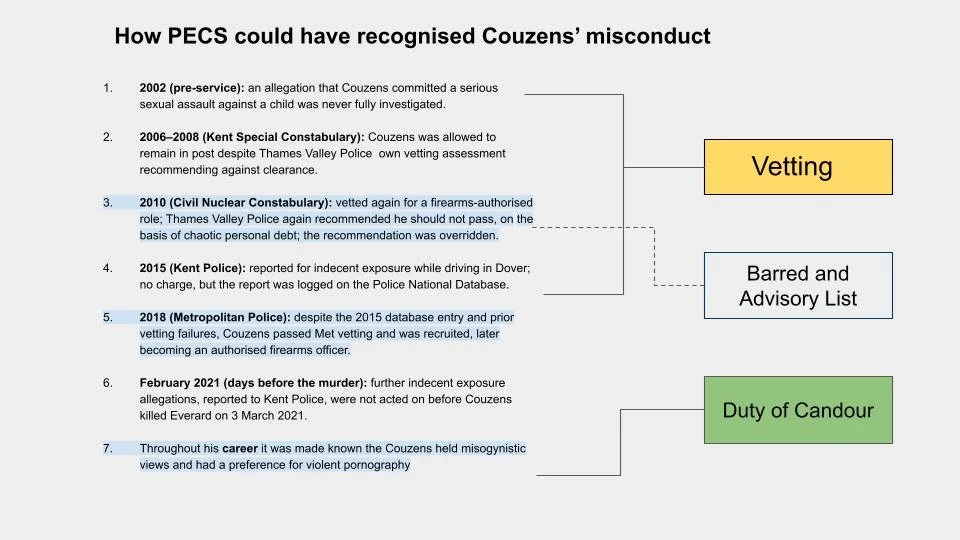
Figure 3 – A timeline of missed opportunities to intervene, and the corresponding changes introduced under PECS.
Whether legislation like PECS would have prevented Sarah Everard’s murder cannot be known. However, the case of former PC Alan Greer has been described by the BBC as ‘Police Scotland’s Wayne Couzens moment’. Greer committed rape, attempted murder and other violent offences over at least 14 years, despite 17 years of apparently unblemished service. Assistant Chief Constable Lynn Ratcliff insisted there were no opportunities to spot his offending sooner, with the investigation only arising after a victim from 2012 came forward last year.
Cases like Greer and Couzens demand legislation that strengthens organisational safeguards and make warning signs impossible to ignore. However, no Act of Parliament can legislate for character. Effective policing ultimately depends on a professional culture grounded in the tenet of public service and the recognition that vetting alone cannot reveal an officer's true nature.
PART 4: RETURNING TO CULTURE
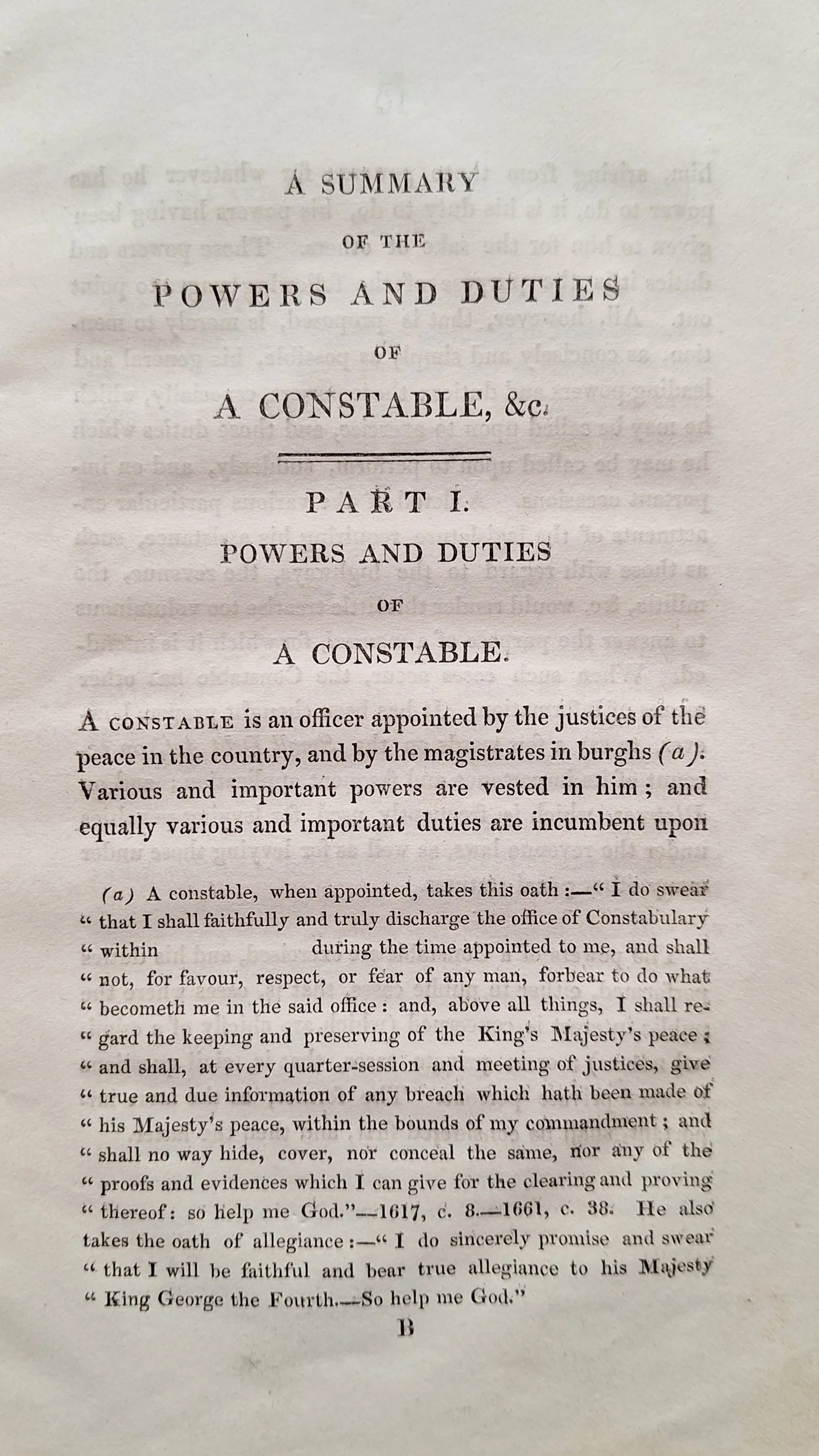
Figure 4 - A Summary of the Powers and Duties of a Constable in Scotland by George Tait Esq. Advocate (1827). This text contains the first reference to a constable’s oath, later enshirned in statute under the Police (Scotland) Act 1857.
We began with the Broom Scandal of 1819, which is not a millstone, but a milestone in the evolution of ethical policing in Scotland. Just eight years later, in 1827, the first recorded constables’ oath emerged, requiring officers to give ‘true and due information’ to superiors and never ‘hide, cover, nor conceal’ evidence. Its attempt to eliminate police misconduct reads remarkably like a duty of candour.
PECS is a positive step towards improved police culture but has clear limitations. The duty of candour creates an explicit expectation to flag misconduct, without addressing the underlying reasons that prevent whistleblowing. The Code of Ethics introduces independent scrutiny and continuous professional education, but risks concentrating solely on individual rather than institutional responsibility. It is folly to think that vetting will be foolproof because human nature is changeable, but it’s necessary.
Values like candour, integrity, fairness and respect have long been central to the duty of Scottish police constables, and this new statutory footing chimes with a deeper cultural policing tradition. We conclude with a caution:
“Well done, good and faithful servant. If you care for any of these things, be diligent, steady, active and honest in the discharge of your duty. I have done mine, and if you will not do yours, the shame and the guilt be upon your own heads.”