
This summer, we have been delighted to welcome so-far two of our three groups of Summer Scholars, who are undertaking dedicated research into critical contemporary issues within the Scottish legal system. Drawing on a combination of online resources, legislative materials and the Signet Library's archives, the scholars have been guided throughout their projects by the Society’s executive team.
PROTECTING VICTIMS & WITNESSES
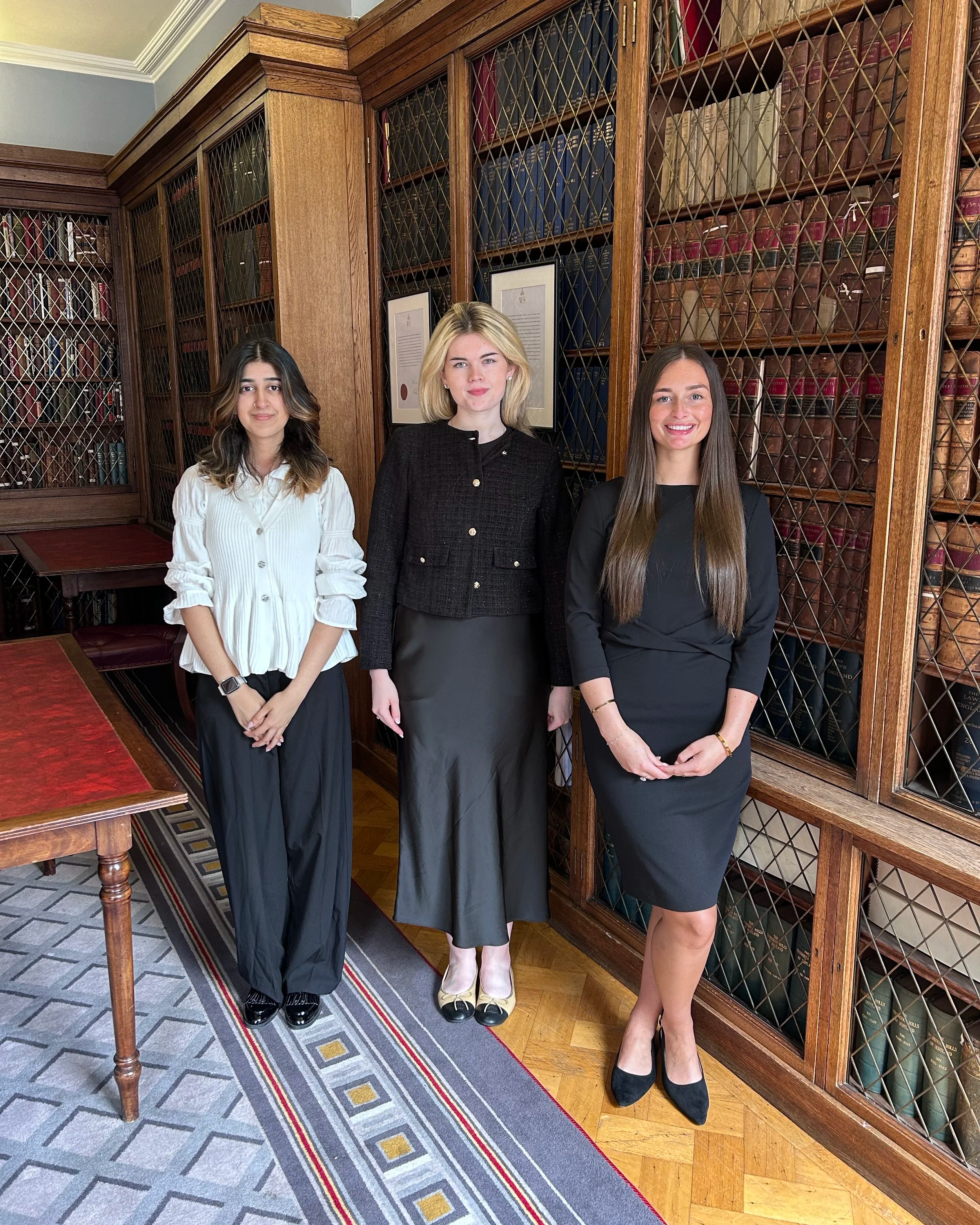
Pictured: Amina Shahid (Glasgow Caledonian University), Emma Gilmour (University of Glasgow) and Elise Douglas (University of Edinburgh).
Our first group of scholars focused their research on the protection of vulnerable witnesses. Their report provides a timely examination of the reforms introduced by the Victims, Witnesses and Justice Reform (Scotland) Act 2025, exploring how these legislative changes are reshaping court procedures and the support available to those engaging with the justice system.
An excerpt from their report can be read below:
Rape Crisis Scotland has welcomed the creation of the specialist court, arguing that it has the potential to improve the experiences of survivors of sexual violence, many of whom have expressed dissatisfaction with the existing court process.
"At the court…it’s as if you’re invisible, or you don’t matter." — Participant 7
In support of this position, Rape Crisis Scotland points to the successful operation of a comparable specialist court in New Zealand, where dedicated judges and the increased use of special measures have contributed to a more trauma-informed approach to hearing evidence.
In contrast, the Law Society of Scotland has criticised the establishment of the specialist Sexual Offences Court as a matter of principle. It argues that creating a specialist court risks causing unnecessary complexity in the judicial system and has expressed concerns about the potential impact on the efficiency and administration of criminal proceedings.
POLICE ETHICS, CONDUCT & SCRUTINY
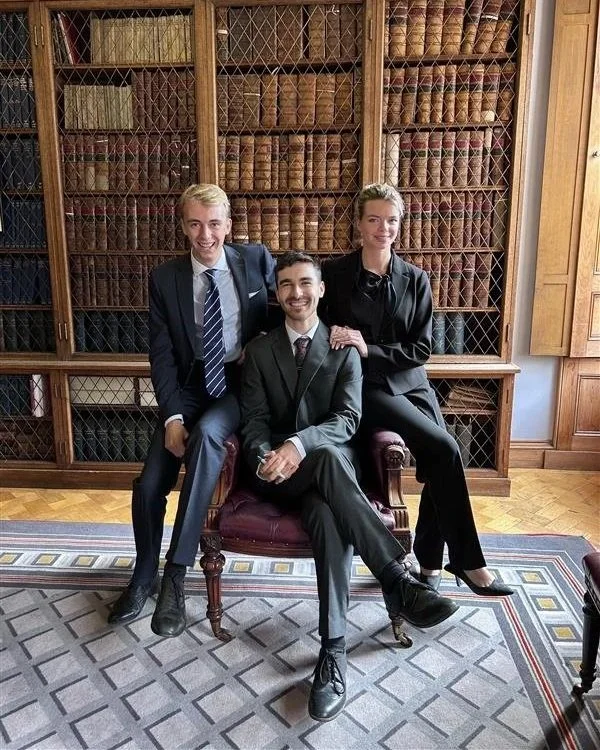
Pictured: Lucy Gallacher (University of Glasgow), Peter Fairhurst (University of Dundee) and William Boagey (University of Aberdeen).
Our second group examined the Police (Ethics, Conduct and Scrutiny) (Scotland) Act 2025, seeking to answer the question: To what extent do a duty of candour and a code of ethics change the culture of Police Scotland?
Their report offers a thoughtful analysis of this significant legislative reform, considering its potential impact on police accountability, professional standards and public confidence in policing, alongside the evolving framework for oversight and scrutiny in Scotland.
An excerpt from their report can be read below:
The year is 1819, and The Broom Scandal has no sooner swept through the City of Edinburgh then it is swept under the rug. Established under the Edinburgh Police Act of 1805, city constables were respected members of the mercantile class, selected for integrity, and fairness.
Until an independent annual audit by the Cleansing Committee stumbled upon a fraudulent scheme. A barred police sergeant, Forsyth, had conspired with the Principal Police Clerk to create phantom bills for brooms. Over a six-year period, the force allegedly purchased 169,572 brooms, the equivalent of £100,640.08 of today's money, at the public's expense.
The 1819 Broom Scandal is the first example of institutional misconduct in new Scottish policing. Two centuries later, as we approach the fourteenth anniversary of Police Scotland, the Police (Ethics, Conduct and Scrutiny) (Scotland) Act 2025 ("PECS"), addresses the same institutional weaknesses by embedding ethical policing standards in law and strengthening independent scrutiny.
LOOKING AHEAD
We warmly invite all WS members and colleagues to join us for the presentation by our final group of Summer Scholars, giving attendees the opportunity to support their work and engage with their research findings.
The online presentation will take place on Thursday 20 August at 2.00 pm and will provide valuable insight into another critical contemporary issue within the Scottish legal system. Attendance will count as one hour of CPD.
To register your interest, please contact Cady Shearsmith at cshearsmith@wssociety.co.uk.