
Lady Elish calls for urgent, co-ordinated action to shift public attitudes, disrupt harm and create a culture that enables women to feel safer.
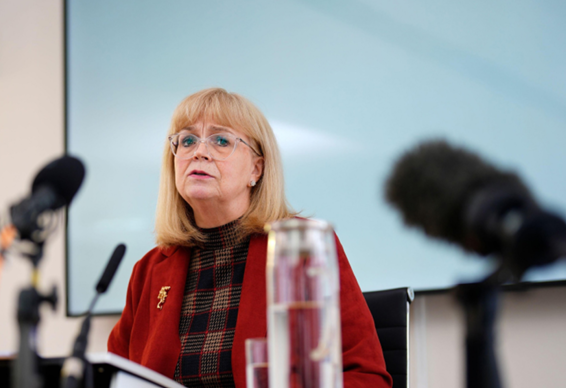
On 2 December 2025, Lady Elish Angiolini released the First Report of Part 2 of the Angiolini Inquiry on “Prevention of sexually motivated crimes against women in public”. Calling for a fundamental shift in the focus of activity to prevent such crimes, the report recommends an emphasis on early intervention in targeting and identifying predatory men.
Lady Elish Angiolini was first commissioned to conduct an independent inquiry into the murder of Sarah Everard by the then Home Secretary Priti Patel in November 2021. Everard was murdered in London in fore, another of the inquiry’s goals was focused on prevention by ensuring greater and earlier recognition of potential sexual and murderous predators, and by improving the safety of women in public spaces.
In Part 1 of the Angiolini Inquiry, published in February 2024, Chair of the Enquiry Lady Elish Angiolini recommended that by September 2024, police forces should ensure they have a specialist policy on investigating all sexual offences, including so-called “non-contact” offences such as indecent exposure. The First Report of Part 2 of the Angiolini Inquiry, released on 2nd December 2025, examined the extent to which existing measures prevent sexually motivated crimes against women in public spaces.
During both press conferences, held at the release of each stage of the report, Lady Elish began by paying tribute to the victims of these dreadful crimes and to their families, beginning with the family of Sarah Everard:
I have been profoundly affected by their grief, and their grace in their suffering. I have also been moved by the courage of those victims who gave evidence to the Inquiry of their own experiences. I am so grateful they trusted us. I hope we have done them justice, and that real change and improvement happens because of this report. I do not underestimate the strength speaking to the Inquiry required of them. I make recommendations for improvements that need to be made to ensure that women feel safe when they report to the police.
Terms of Reference for Part 2 of the Inquiry summed up its overarching aim as establishing whether there is a risk of recurrence across policing, to investigate police culture, and to address the broader concerns surrounding women’s safety in public spaces that were highlighted by Sarah Everard’s death. Her family, Sue, Jeremy, Katie and James Everard released a statement on 2nd December 2025 coinciding with the first stage of this part of the enquiry, thanking Lady Elish and her team “for keeping Sarah in their thoughts in this part of the Inquiry. It has meant so much to us.” In their press release the family also paid tribute to the incredible scale of the work undertaken by the Inquiry:
The report is an impressive document and the result of painstaking and meticulous research and analysis. We would like to thank Lady Elish and her team for their important work in helping to keep women safe. Their work has been a solace to us and we are indebted to them for the kindness and support they have shown our family.
On 2nd December 2025, Lady Elish summarised the report’s latest findings. Headlines across all forms of media echoed her serious warning that urgent national action was needed to stop sexual predators from committing sexually motivated crimes against women. Whilst Lady Elish stated measures for making public spaces safer were important – such as better street lighting, advising women on how to protect themselves, providing information on safe routes home – she reminded everyone that they were not enough. Prevention focus, the report made clear, must be squarely on identifying and targeting the predatory men who commit these crimes. There needs to be much more work to identify and intervene early when someone is showing predatory behaviour, and to investigate swiftly and effectively when an offence has taken place.
These findings echoed Part 1 of the report which found that Wayne Couzens, the murderer of Sarah Everard, should never have been a police officer, and that countless opportunities were missed to stop him. Couzens’ police career spanned nearly twenty years and, in that time, it was found he enjoyed the “powers and privileges that accompany the role of police officer” whilst three separate police forces failed to address repeated, unacceptable sexually motivated behaviour and sexual offences such as indecent exposure. Following a statement on Part 1 the Angiolini Inquiry to the House of Commons in February 2024, the National Police Chief’s Council Chair, Gavin Stephens, said the findings left him “aghast”. “Across history,” Stephens continued, “there are crimes that send a signal to us all, a signal not just about the depravity of the perpetrator, but one of problems in our society or failures in our institutions. This is a glowing red signal to all police leaders that we must do everything humanly possible to enact these recommendations and change policing for future generations”.
Yet, over eighteen months later, one of Lady Elish’s main conclusions was how little progress police forces had made in implementing the recommendations. Noting that the findings were unanimously accepted across government and the justice system, she expressed her disappointment at the pace and scale of change, in characteristically no-nonsense language: “There is no better time to act than now. I want leaders to, quite simply, get on with it. There are lives at stake”.
Lady Elish expressed her view that the main problem with progress in the four and a half years since the abduction and murder of Sarah Everard was the lack of consistent and unified action across police forces, which she labelled “deeply disappointing”. The December report also found it of great concern that there was so little data available to answer the most basic questions on how many women nationally had reported being the victim of sexually motivated crimes in public areas. Data was still not being gathered systematically and consistently across police forces, preventing potential analysis of patterns of offending. This was seen as a critical failure.
In her First Report on Part 2 of her Inquiry, Lady Elish also addressed the dangers of social media and online pornography. Whilst noting that the safety of online spaces was not within the report’s Terms of Reference, she explained “nearly every witness shared their concerns about the impact that violent misogynistic pornography and unfettered access to harmful content has on users”. Lady Elish reminded the journalists that in the first part of her report she had been “resolute” in highlighting Wayne Couzens’ interest in extreme and violent pornography. Online spaces, she concluded “are becoming increasingly violent and degrading places, where misogyny and hatred towards women not only flourishes, but is disgustingly celebrated”. It was inconceivable, she went on, that there were not better safety measures in place for online content, not just to protect women and girls, but also men and boys.
This precis gives some idea of the incredible scale of the task facing the Inquiry. Lady Elish’s third report will concentrate on policing in more detail, including recruitment, vetting, transfers, standards and culture. In its final stages, the Inquiry will be going on to examine the crimes of David Carrick, a former Metropolitan police officer who was sentenced in February 2023 and again in November 2025 for numerous crimes against women. By seeking to understand how he was able to remain in policing for a prolonged period, the Inquiry will address the broader issues raised by both the Couzens and the Carrick cases as well as other tragedies in respect of the policing and protection of women.
— ROBERT PIRRIE WS
“We would like to thank Lady Elish and her team for their important work in helping to keep women safe. Their work has been a solace to us and we are indebted to them for the kindness and support they have shown to our family.”