
The early eighteenth century saw the first flowering of what would later become the Scottish Enlightenment. There were intellectual giants in the land – Sir Robert Sibbald, founder of the Physic Garden; Alexander Gordon, the great historian of the Romans in Scotland; the classicist and publisher Thomas Sibbald; Father Thomas Innes, scourge of the idea of Scotland’s Ancient Monarchy; and the great historian and Writer to the Signet, James Anderson. Writing in 1858, a contributor to Notes and Queries said of a letter he was transcribing that it was “..curious in showing there did exist a portrait of Anderson. What has become of it is not known; and it is much to be regretted that there is no engraving of a man who did so much for the history of Scotland.”
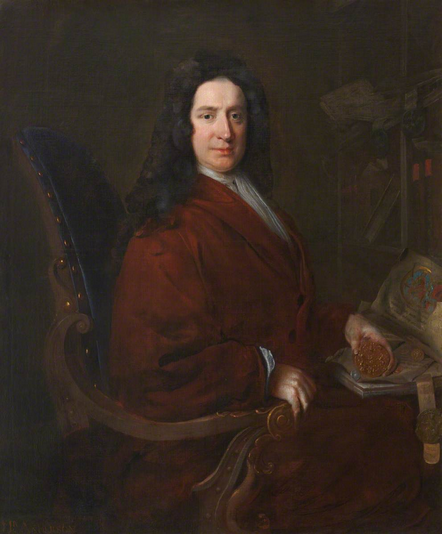
By that stage, the picture, misattributed to John Vanderbank (c. 1694-1739), had been displayed in the Signet Library for almost ten years. It shows Anderson as the proud antiquary, surrounded by the books and ancient documents that consumed his life. There is something odd about the picture’s frame, which was originally considerably larger but has been cut down to fit the portrait.
In 1714 George Lockhart related a story about the picture. Anderson had been in London, trying to elicit patronage and funding from the chief minister Robert Harley, Lord Oxford. Harley attempted to flatter Anderson, and at length told him that no doubt he had heard that in his fine library he had a collection of the pictures of the learned both antient and modern, and as he knew none who better deserved a place ther than Mr. Anderson, he desired the favour of his picture. As Mr. Anderson took this for a high mark of the Treasurer’s esteem and a sure presage of his future favours, away he went and got his picture drawn by one of the best hands in London, which being presented, was graciously received (and perhaps got its place in the library) but nothing ever more appeared of His Lordships favour to this gentleman, who having thus hung on and depended for a long time, at length gave himself no further trouble in trusting to or expecting any favour from him; from whence, when any one was asked, what place such or such a person was to get, the common reply was, A place in the Treasurer’s library... (George Lockhart of Carnwath, “Memoirs and Commentaries Upon the Affairs of Scotland from 1702 to 1715” in The Lockhart Papers edited Antony Aufrere (London: published for William Anderson, 1817) Vol. 1 p.371)
Other than it not being Vanderbank, we do not know the artist, although the picture bears features in common with works coming from the studio of Sir Godfrey Kneller, whose Kit-cat Club portraits also date from this period and who would paint Harley himself in the year of Lockhart’s account.